It’s that time of year in the United States when people across the country change their clocks for US Daylight Saving 2026. This yearly change has a lot of Americans scratching their heads wondering just exactly when clocks need to be moved forward or turned back. There are people who do not even know if clocks go forwards or backward. Some people asked whether they’re getting an extra hour of sleep or losing one. Daylight Saving Time 2026 will follow the same system that has been used in so many prior years in the United States. Read this for what you need to know about United States Daylight Saving Date 2026 and how states are working to protect us from its cons.
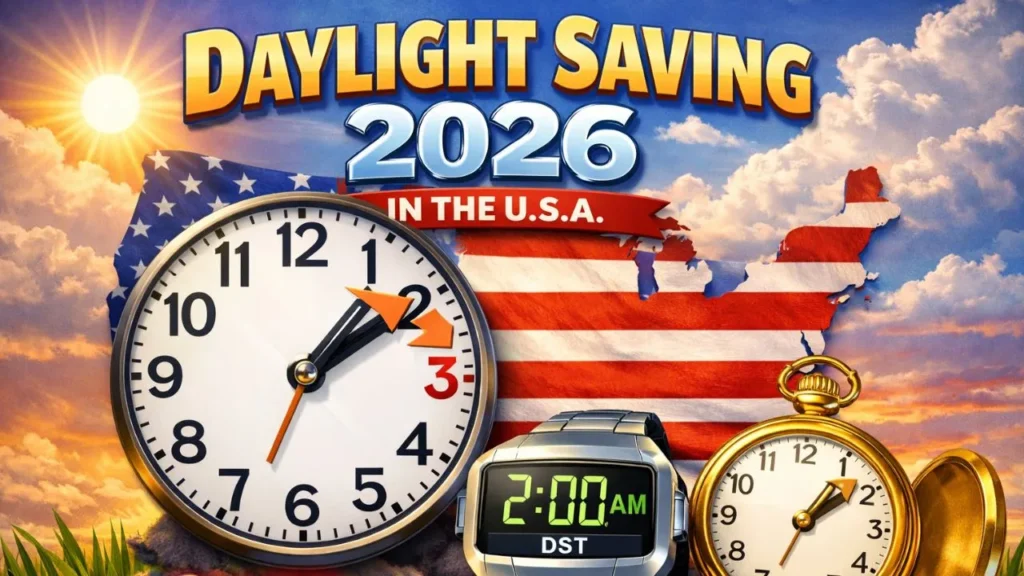
US Daylight Saving 2026
The U.S. capitalizes on natural light by observing Daylight Saving Time (DST), turning clocks forward one hour in the spring, and back again in the fall. In the warmer half of the year, US Daylight Saving 2026 acts to extend evenings at the cost of ‘using’ early morning daylight by one hour, so that evenings have more daylight and mornings have less. Evening daylight is what DST is all about, because it was originally assumed to reduce energy consumption and encourage outdoor activities. This Daytime Saving is not for all states of the USA, and Hawaii, most of Arizona, and some other territories including American Samoa decide to remain on standard time throughout the year.
United States Daylight Saving Date 2026
| About | US Daylight Saving |
| Year | 2026 |
| Country | USA |
| United States Daylight Saving Date 2026 | Sunday, 8th March 2026 |
| DST End Time | Sunday, November 1st 2026 |
| Changes | 2:00 a.m. The clock shifted to 3:00 a.m. |
| Rules Of This Change | The main thing the government has to do is to check the dates of changes . All changes must be on time otherwise citizens will face difficulties. |
| Change by season | Spring forward 1 hr, and fall back 1 hr |
| Category | US Finance |
| States are not becoming part | Hawaii and most of Arizona and many other US territories stay on previous timings |
US Daylight Saving 2026 New Timing & Dates
| Event Name | Date | Time | What Happen |
| DST Start (Spring Forward) | 8th March,2026 | 2:00 a.m to 3:00 a.m | Clock moves forward for 1 hr |
| DST End(Fall Back) | 1st November,2026 | 2:00 a.m to 1:00 a.m | Clock moves back for `1 hr |
Effects Of This US DST Change 2026
Health Impacts
- Daylight saving time transition is associated with sleep deprivation due to a reduction in sleep by 1 hr for most individuals.
- Medical studies have documented a transient spike in heart attacks and strokes after the springtime clock change.
- disarranging from your circadian rhythm will make you tired, irritable and which means of slower mental function.
- Kids and seniors have a harder time adjusting their sleep schedules.
Automobile Safety Impacts
- So we have more traffic incidents in the days right after daylight saving time change over and spring forward.
- Accidents in the workplace rise as attention and reactions lag.
- Darker mornings make it harder for people to see and create more risks, especially for schoolchildren and commuters.
Economic Impacts
- Employee productivity diminishes in the initial week following the spring transition.
- Retail sales and expenditures on outdoor recreation rise as a result of extended evening daylight.
- Companies suffer from scheduling inabilities, especially when they are set across time zones.
Energy Impacts
- This is not supported by current research, which finds that net energy savings from DST are minimal.
- Evening electricity consumption diminishes marginally, however morning heating and lighting requirements escalate.
- The initial energy conservation objective of Daylight Saving Time is mostly obsolete.
Impact of Education and Family
- Students have trouble staying on track and being punctual post time change.
- Children are seen as having more irritability and disturbed sleep.
- A school size up is more challenging on darker mornings.
Technology and Coordination Effects
- International communication and travel encounter transient scheduling ambiguities during transitions.
- Computer systems and software necessitate intricate programming to accommodate temporal alterations.
- Errors associated with time computation escalate during Daylight Saving changes.
Policy and Public Sentiment
- Public support is increasing for the abolition of biannual clock adjustments.
- Numerous states endorse reform but necessitate legislative authorization for the implementation of permanent Daylight Saving Time.
- The national discourse persists on the adoption of either permanent standard time or perpetual daylight time.
How To Prepare For US Daylight Time Change In 2026
To facilitate a seamless transition:
- Move bedtime up slowly starting a few days before March 8.
- Get as much natural light in the morning as possible after you switch over.
- Avoid caffeine late in the afternoon or at night.
- Check on travel and for any important appointments.
FAQs On US Daylight Saving 2026
What is the starting date of DST?
The starting date must be 8th March,2026
When will DST end?
The last date of DST will be 1st November 2026.
In March 2026, might clocks move ahead or back instead?
March moves the clocks forward by one hour.
Do we lose or gain an hour of sleep in March?
Daylight saving puts you down one hour of sleep.
What will happen to clocks in November 2026?
Time changes back one hour to standard time.
Does November bring us sleep or take it away?
In November, you gain an hour of sleep.
Which countries follow the U.S. in changing their clocks to Daylight Saving Time?
There are only regulations for Daylight Saving Time in the US and they vary across countries.